If you’ve ever reset your password three times in a single day, congratulations—you’ve already experienced the past of Identity and Access Management (IAM).
The future? It’s far more interesting. And thankfully, far less annoying.
Let’s take a walk into what IAM is becoming—a world where identity is not just something you prove, but something that intelligently represents you.
Identity: From Static to Living, Breathing Digital You
Traditionally, identity has been… well, boring.
- Username
- Password
- Maybe a one-time code if you’re lucky
But the future of IAM is turning identity into a dynamic, context-aware digital persona.
Instead of asking “Is this really you?” once, systems will continuously evaluate:
- Your behavior (typing speed, mouse patterns 🖱️)
- Your device posture (secure or compromised?)
- Your location and risk signals
- Your historical patterns
Identity becomes less like a passport and more like a live conversation.
Goodbye Passwords, Hello Invisible Security
Passwords are the villains of modern cybersecurity.
In the future, they quietly fade away and are replaced by:
- Biometrics (face, fingerprint, maybe even gait)
- Device-based trust (your phone becomes your key)
- Cryptographic authentication (keys instead of secrets)
This is already happening with passkeys—but we’re just scratching the surface.
Imagine logging into everything without ever thinking about authentication.
No friction. No resets. No sticky notes with passwords (you know who you are 😄).
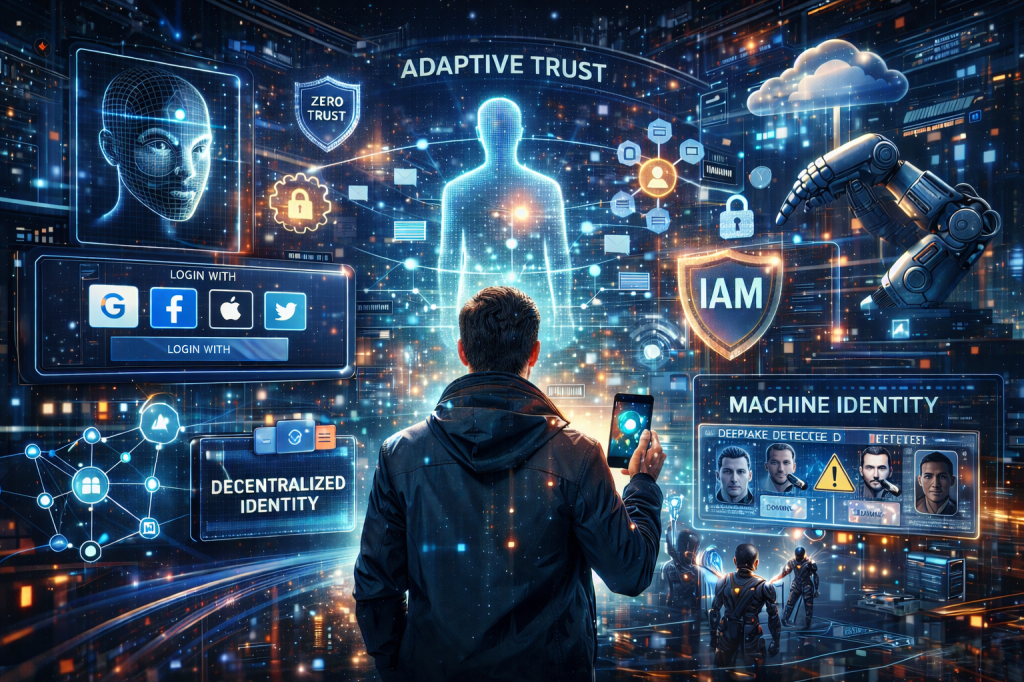
Zero Trust Becomes “Adaptive Trust”
You’ve probably heard of Zero Trust: never trust, always verify.
The future evolves this into something smarter:
Adaptive Trust: Trust—but continuously validate based on risk.
Instead of blocking everything unusual, systems will:
- Adjust access in real time
- Reduce permissions if risk increases
- Step up authentication only when needed
It’s like having a security guard who learns your habits instead of treating you like a stranger every time.
AI + IAM = Predictive Security
Here’s where things get exciting.
AI will transform IAM from reactive to predictive:
- Detect suspicious behavior before a breach happens
- Predict insider threats based on anomalies
- Recommend least-privilege access automatically
Your identity system won’t just protect you—it will anticipate problems.
Think of it as a cybersecurity co-pilot that whispers:
“Hey… something doesn’t feel right here.”
Decentralized Identity: You Own You
Today, your identity is scattered across hundreds of platforms.
In the future, identity shifts toward user ownership:
- Self-sovereign identity (SSI)
- Verifiable credentials
- Blockchain-backed identity proofs
Instead of companies storing your data, you will present cryptographic proof of:
- Who you are
- What you’re allowed to do
- What you’ve achieved
No more “Sign up with 47 different accounts.”
No more massive identity breaches leaking your data.
IAM Moves Beyond Humans
Here’s a twist: humans won’t even be the majority of identities anymore.
The future is full of:
- APIs talking to APIs
- Machines authenticating machines
- AI agents acting on your behalf
These non-human identities will need:
- Strong authentication (certificates, keys)
- Fine-grained authorization
- Lifecycle management
In fact, managing machine identities may become more important than managing human ones.
The Workplace Without Boundaries
The concept of a “corporate network” is dissolving.
Future IAM will support:
- Work from anywhere
- SaaS-to-SaaS communication
- Multi-cloud environments
- Partner and vendor ecosystems
Access decisions won’t depend on where you are, but on:
- Who you are
- What you need
- How risky the situation is
The Ultimate Goal: Security That Disappears
The endgame of IAM is surprisingly simple:
Make security so seamless that users don’t notice it.
No friction.
No unnecessary prompts.
No confusion.
Just:
- The right access
- At the right time
- For the right identity
Final Thought: Identity Is the New Perimeter
Firewalls used to define security boundaries.
Now?
Identity is the perimeter.
And in the future, that perimeter will be:
- Intelligent
- Invisible
- Decentralized
- Continuously adapting
So the next time you log in (or don’t even realize you did), remember:
You’re not just accessing a system.
Your digital identity is negotiating trust on your behalf—every second.
Welcome to the future of IAM. It knows you better than your passwords ever did.

 cyber Adventura
Leave a comment