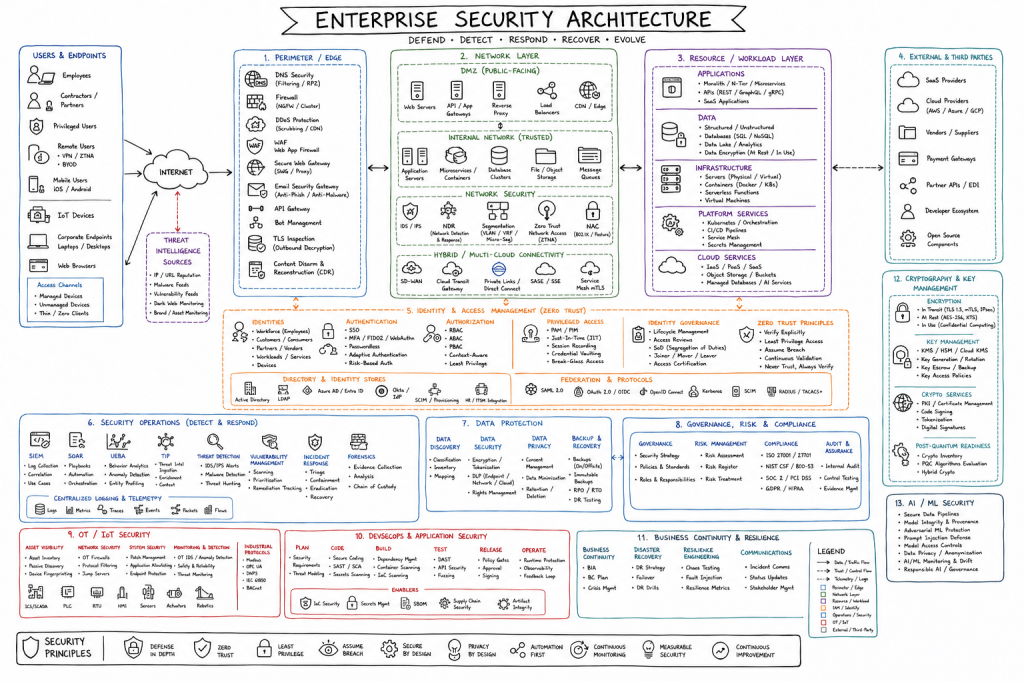
Last week, I proudly unveiled my brand-new Enterprise Security Architecture diagram.It was beautiful.It had colors.It had arrows.It had so many boxes that a project manager mistook it for a new apartment complex.My whiteboard looked less like a security architecture and more like the blueprint for a futuristic city governed entirely by compliance officers
The Beginning: “Let’s Keep It Simple”
Every security architect starts with noble intentions.”Let’s draw a simple architecture.”Five minutes later:
- Internet
- Firewall
- Applications
Done ! Elegant ! Minimalist !
Then someone from networking walks in.
“Where’s the DMZ?”
Good point.
Add a DMZ.
Then someone from IAM appears out of thin air.
“Where’s MFA?”
Add MFA.
A cloud architect joins.
“Where’s multi-cloud?
“Add Azure.Add AWS.Add GCP“
Add another cloud because apparently three clouds are not enough clouds.
Suddenly the diagram resembles the subway map of a city that doesn’t actually exist.
Enter Zero Trust
Zero Trust is like that fitness coach who never lets you relax.Every request must be verified.Every user must authenticate.Every device must prove its innocence.Every workload must present identification.Even the coffee machine now requires MFA.One morning I attempted to print a document.The printer asked:
“Please provide biometric verification, device posture assessment, risk score, and a blood sample.”
Progress
Identity and Access Management:The Department of Endless Login Screens
Identity is the beating heart of enterprise security.In theory:
- Single Sign-On means one login.
In reality:
- SSO Login
- MFA Challenge
- Adaptive MFA Challenge
- Conditional Access
- CheckDevice Compliance
- CheckCAPTCHA
By the time you’ve logged in, you’ve forgotten why you logged in.
AI Security: Because Now the Servers Think
In the old days we worried about hackers.Now we worry about hackers using AI.And AI accidentally helping hackers.And AI helping defenders defend against hackers using AI.My architecture now includes:
- AI Governance
- AI Monitoring
- Prompt Security
- Model Protection
- Model Provenance
- AI Risk Management
The AI itself has started asking for security awareness training.Last week our large language model reported a phishing email.I was both proud and slightly concerned.
Cryptography:Turning Data Into Expensive Randomness
Cryptography is magical.Take valuable data.Apply enough mathematics.Turn it into complete nonsense.
The goal is simple:If attackers steal your database, they should feel like they’ve downloaded an advanced calculus textbook written in ancient Greek.Our architecture now includes:
- PKICertificates
- HSMs Key Rotation
- Digital Signatures
- Encryption at Rest
- Encryption in Transit
- Encryption While Thinking About Transit
Every six months somebody asks:
“Where is the encryption key?”
And everyone suddenly becomes very interested in vacation schedules.
OT Security:Where Rebooting Is Considered A Career-Limiting Move
Enterprise IT people love patching.OT engineers fear patching.IT Team:
“Let’s reboot everything tonight.”
OT Team:
“That machine controls a chemical process, a conveyor belt, and possibly civilization itself.”
In OT environments:
- PLCs are older than some employees.
- Documentation exists only in legends.
- The original vendor retired in 1998.
- The password is stored in a binder labeled “DO NOT TOUCH.”
When IT and OT teams meet, it resembles a diplomatic summit between two neighboring kingdoms.
Security Operations:The SOC Never Sleeps
The Security Operations Center is where alerts go to multiply.
At 2:00 AM:
Alert 1: Suspicious login.
Alert 2: Malware detected.
Alert 3: User clicked phishing link.
Alert 4: User clicked phishing link again.
Alert 5: User replied to phishing email asking if it was legitimate.
Analysts stare at dashboards containing more graphs than a stock exchange.
Coffee becomes a critical security control.
Governance, Risk and Compliance:The Adult Supervision Layer
Architects build things.Engineers deploy things.Compliance asks:
“Can you prove it?”
This is why governance exists.Without governance:
- Chaos.
With governance:
- Organized chaos documented in triplicate.
Every control eventually becomes:
- A policy
- A procedure
- A standard
- An audit finding
- A remediation plan
- Another meeting
Mostly another meeting.
The Final Architecture
After months of work, the architecture finally contained:
- Zero Trust
- IAM
- PAM
- SIEM
- SOAR
- AI Security
- Cryptography
- Cloud Security
- OT Security
- DevSecOps
- Threat Intelligence
- Governance
- Compliance
- Business Continuity
- Disaster Recovery
And approximately 9,000 arrows.When executives looked at it, they nodded thoughtfully.One asked:
“Can you make it simpler?”
I replied:
“Certainly. We can remove half the controls.”The room became silent.
Conclusion
Enterprise Security Architecture is a lot like parenting a family of highly intelligent, slightly paranoid technologies.
The firewalls don’t trust the applications.
The applications don’t trust the users.
The users don’t trust the MFA prompts.
The AI doesn’t trust the prompts.
The OT engineers don’t trust anyone.
And somehow, through a miracle of architecture, governance, and caffeine, the whole thing keeps running.Until somebody plugs an unknown USB stick into a factory controller.Then all bets are off.
Stay secure. Stay patched. And remember: if your architecture diagram fits on one page, somebody from security, cloud, AI, OT, networking, or compliance hasn’t reviewed it yet.
 cyber Adventura
Leave a comment