Perhaps it’s a bit late ! February, 2026, I had the privilege to visit the Gartner Identity and Access Management summit in London. Two intense days of presentations, deep dive sessions, workshops, one on one meetings that focussed on the latest trends in identity and access management topics !
The take away messages were not lost !
The Gartner Identity and Access Management Summit 2026 highlighted a major shift in how organizations must view identity.
Identity is no longer simply about authenticating users and managing access rights. It has evolved to be the foundational security control that connects people, machines, workloads, and more importantly AI agents, devices, and digital services across increasingly complex ecosystems.
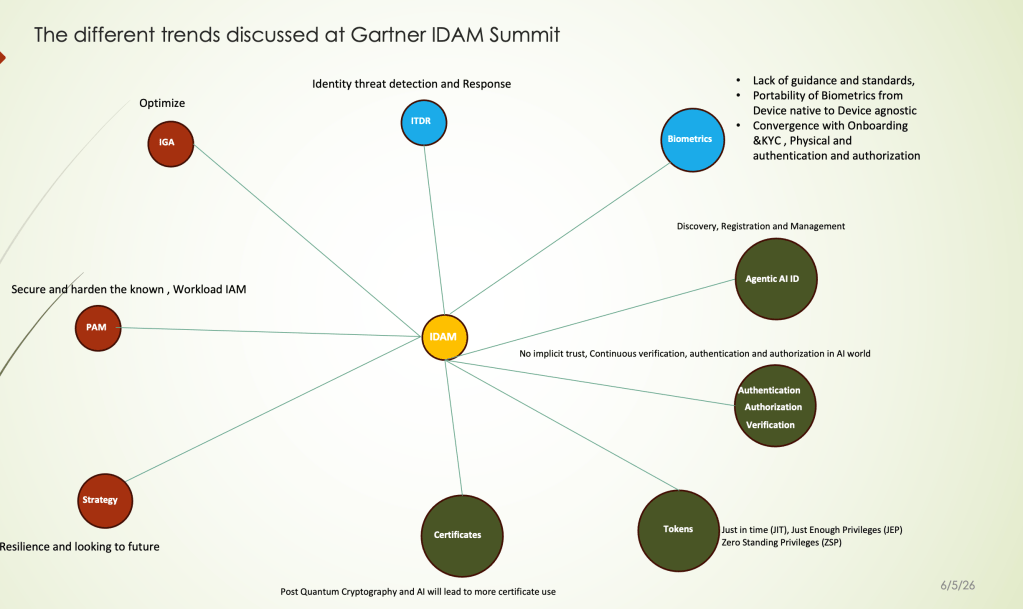
1. Identity as the New Security Perimeter
At the center of the discussion was Identity and Access Management (IDAM) as the core enabler of cybersecurity resilience, digital trust, and AI adoption.
Traditional network boundaries will continue to disappear as organizations embrace cloud computing, hybrid work, AI, IoT, and digital ecosystems. As a result, identity has become the primary control point for security decisions.
The summit reinforced the principle that organizations must pivot beyond perimeter-based security and embrace:
- Continuous verification
- Context-aware access decisions
- Risk-based authentication
- Zero Trust architectures
The underlying message was clear: every access request must be verified, regardless of origin.
2. Authentication, Authorization and Verification in the AI Era
One of the strongest themes was the convergence of authentication, authorization, and continuous verification.
In an environment where AI agents increasingly act on behalf of humans, organizations can no longer rely on one-time authentication events. Instead, they must establish:
- Continuous identity validation
- Behavioral analysis
- Dynamic authorization
- Adaptive access controls
The concept of “never trust, always verify” is evolving into “continuously verify” as identities become more dynamic and autonomous.
3. Agentic AI Identity: The Next Frontier
A major emerging topic was Agentic AI Identity.
As organizations deploy autonomous AI agents capable of making decisions and executing actions, fundamental questions arise:
- How are AI agents discovered?
- How are they registered?
- Who owns them?
- What permissions must they receive?
- How to maintain accountability ?
Future IAM platforms will need capabilities to manage AI identities in the same way they manage human and machine identities today.
This introduces a new identity category:
- Human identities
- Machine identities
- Workload identities
- Device identities
- AI agent identities
The governance and lifecycle management of AI agents is expected to become one of the fastest-growing IDAM domains over the next several years.
4. Identity Threat Detection and Response (ITDR)
Identity attacks continue to be one of the most effective attack vectors used by adversaries.
The summit emphasized the growing importance of Identity Threat Detection and Response (ITDR), which focuses on:
- Detecting compromised accounts
- Monitoring privilege abuse
- Identifying identity-based attack paths
- Detecting suspicious authentication patterns
- Responding to identity-centric threats
Organizations are increasingly integrating ITDR capabilities with:
- SIEM
- SOAR
- XDR
- Identity Governance platforms
The goal is to make identity signals a first-class security telemetry source.
5. Certificates and the Rise of Machine Identity
Machine identities received considerable attention.
With cloud-native architectures, APIs, containers, IoT devices, and AI workloads expanding rapidly, organizations are managing exponentially more certificates than ever before.
The summit highlighted that:
- Machine identities already outnumber human identities by a large margin.
- Certificate lifecycle management is becoming a strategic capability.
- Automated certificate issuance and rotation are essential.
Additionally, the arrival of Post-Quantum Cryptography (PQC) is expected to drive another major wave of certificate modernization.
As quantum-resistant cryptographic standards emerge, organizations will need to:
- Inventory certificates
- Modernize PKI infrastructures
- Implement crypto-agility
- Prepare for large-scale certificate replacement programs
6. Tokens, Just-in-Time Access and Zero Standing Privileges
Traditional static access models are increasingly viewed as high risk.
The summit emphasized modern access principles such as:
- Just-in-Time (JIT) Access : Users receive elevated privileges only when needed.
- Just Enough Privilege (JEP) : Users receive only the minimum permissions required.
- Zero Standing Privileges (ZSP) : Persistent administrative privileges are eliminated.
These approaches reduce attack surfaces while supporting operational agility.
Token-based authorization frameworks are expected to become increasingly granular, dynamic, and context-aware.

7. Biometrics: Beyond Devices and Silos
Biometric authentication continues to evolve, but several challenges remain:
- Lack of universal standards
- Limited portability between platforms
- Vendor-specific implementations
- Privacy and governance concerns
Future biometric systems are expected to become:
- Device agnostic
- Interoperable
- Integrated with digital onboarding
- Connected to KYC processes
The convergence of physical identity, digital identity, authentication, and authorization is expected to accelerate.
8. Previlged Access Management and Workload Identity Security
Privileged Access Management (PAM) remains a critical pillar of enterprise security.
However, the focus is expanding beyond traditional administrator accounts to include:
- Cloud workloads
- Service accounts
- APIs
- Containers
- Kubernetes workloads
- AI services
Organizations are increasingly looking to secure and harden all privileged identities, whether human or machine.
This reflects a broader shift toward Workload Identity Management as a strategic security discipline.
9. Identity Governance and Administration (IGA) Optimization
Many organizations have already deployed Identity Governance and Administration solutions. The challenge now is optimization rather than initial implementation.
Key focus areas include:
- Automation of joiner-mover-leaver processes
- Access certification modernization
- Role mining and entitlement optimization
- AI-assisted governance
- Policy simplification
The objective is to reduce identity complexity while improving compliance and operational efficiency.
10. Strategic Resilience and Future Readiness
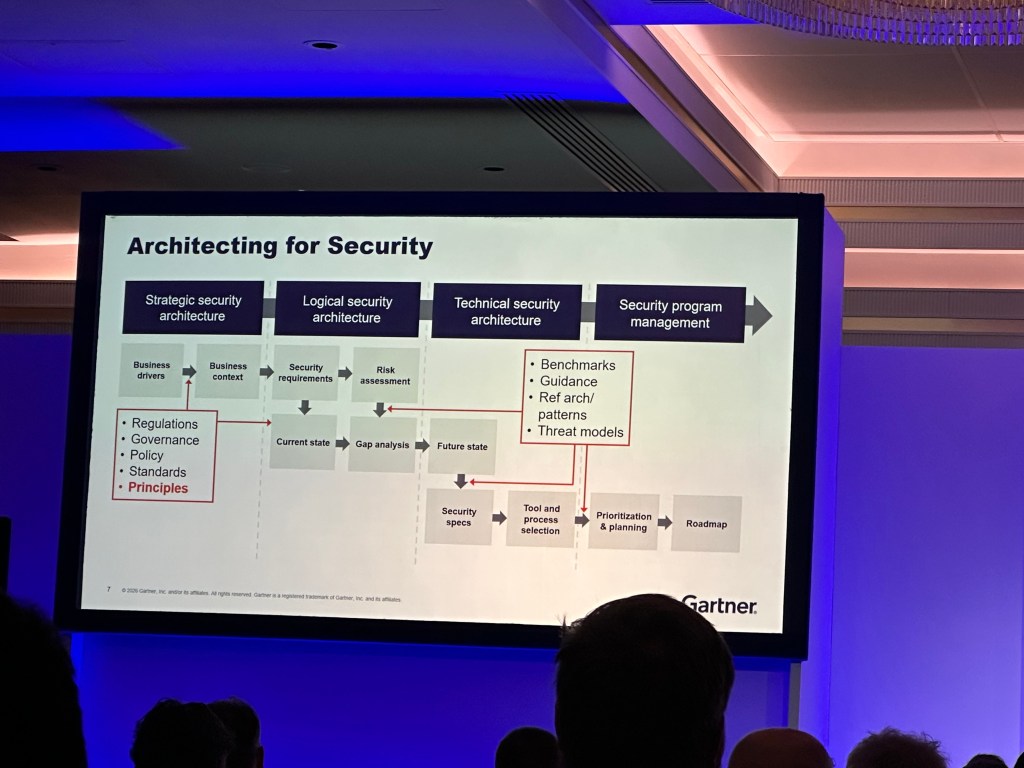
The summit concluded with a strong emphasis on identity strategy and resilience.
Organizations are being encouraged to prepare for:
- AI-driven business models
- Autonomous digital workers
- Quantum-resistant cryptography
- Expanding machine ecosystems
- Regulatory evolution
- Increasing identity-based attacks
Identity is no longer merely an IT function—it is becoming a strategic business capability that enables trust, security, and digital transformation.
Key Takeaway
The Gartner IAM Summit 2026 demonstrated that the future of identity is expanding far beyond users and passwords. The industry is moving toward a world where humans, machines, workloads, devices, certificates, and AI agents all possess identities that must be governed, authenticated, authorized, monitored, and protected.
Organizations that successfully integrate Zero Trust, ITDR, machine identity management, Agentic AI governance, modern PAM, and post-quantum readiness will be best positioned to build secure and resilient digital ecosystems for the next decade.
Fortunately, the lavish buffet of mouthwatering food and drinks made it much easier to digest the generous helping of information that was thrown at us throughout the 2 day session.


Leave a Reply