We have spent decades understanding cybersecurity and its impact on our lives.
As attackers became smarter, defenders evolved alongside them. Security technologies became more sophisticated, security professionals became more knowledgeable, industry associations published frameworks and best practices, regulators introduced guidance and compliance requirements, and management teams worked diligently to keep cyber risk within acceptable levels.
For years, it felt like a giant game of cat and mouse. The attackers would innovate, the defenders would adapt, and the balance would eventually be restored.
Then came Artificial Intelligence.
And suddenly, the rules changed.
We are entering an era where attackers can manufacture malware at factory scale. What once required a team of skilled adversaries can now be automated, replicated, and deployed by AI systems capable of operating around the clock without fatigue, distraction, or budget constraints.
A single overlooked vulnerability can become the target of thousands of automated attack attempts within minutes. AI can craft phishing campaigns, generate exploit code, create convincing fake identities, and launch attacks at a speed that challenges even the most mature security operations.
Perhaps one of the most alarming developments is Mythos Preview, Anthropic’s experimental AI capability that has sent shockwaves through the cybersecurity community. Despite its almost poetic name, Mythos demonstrated capabilities that many security professionals hoped would remain science fiction for a little longer. Reports suggest it can identify and exploit previously unknown vulnerabilities across major operating systems and web browsers with a level of efficiency that few human experts can match.
But this article is not just about Mythos.
Mythos is merely a glimpse into a future that is arriving much faster than most organizations expected.
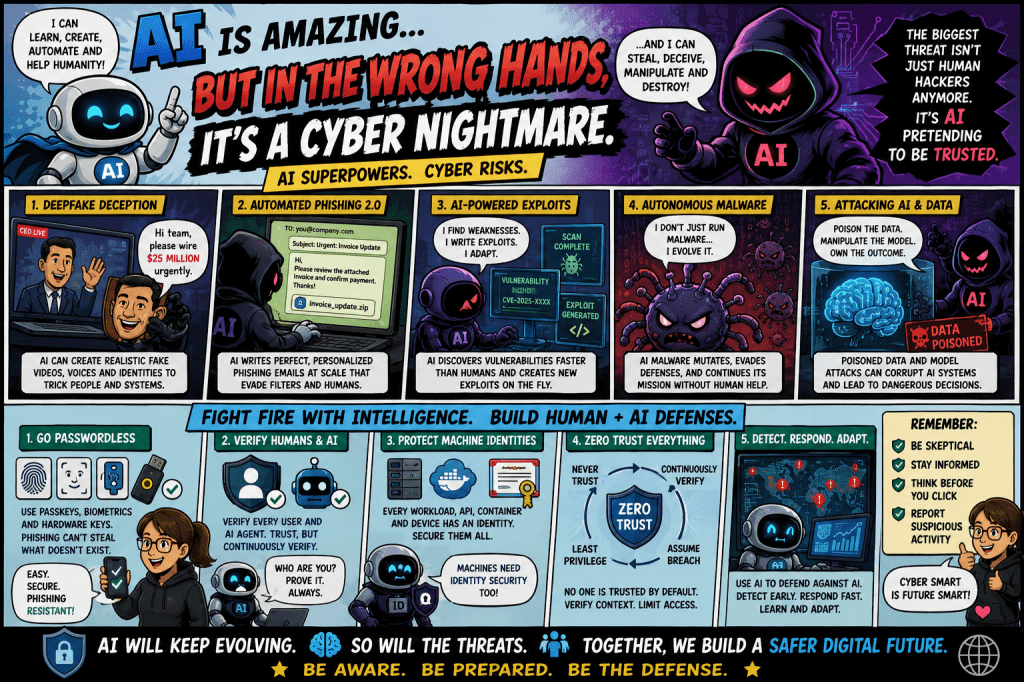
Can we imagine a world where:
- AI creates convincing fake news websites in seconds?
- Deepfake CEOs instruct employees to transfer millions of euros?
- Autonomous malware learns and adapts while an attack is underway?
- AI agents continuously probe organizations for weaknesses without human intervention?
- Synthetic online personas manipulate public opinion at an industrial scale?
- Attackers launch thousands of personalized phishing campaigns tailored to individual victims?
- AI-generated content makes it increasingly difficult to distinguish truth from fiction?
These are no longer plots from a cyberpunk movie or episodes from Black Mirror !
They are emerging realities.
The same technology that helps us write code, create art, summarize meetings, and accelerate innovation can also be weaponized to deceive, manipulate, and attack.
AI itself is neither good nor bad. It is simply a force multiplier.
The question is no longer whether AI will transform cybersecurity.
The question is whether defenders can evolve as quickly as the machines that are changing the battlefield.
Welcome to the age of AI-powered cybersecurity.


Leave a Reply